PRA STRENGTHENS NATIONAL RECLAMATION OVERSIGHT, GOOD GOVERNANCE UNDER CHAIRMAN ALEXANDER T. LOPEZ

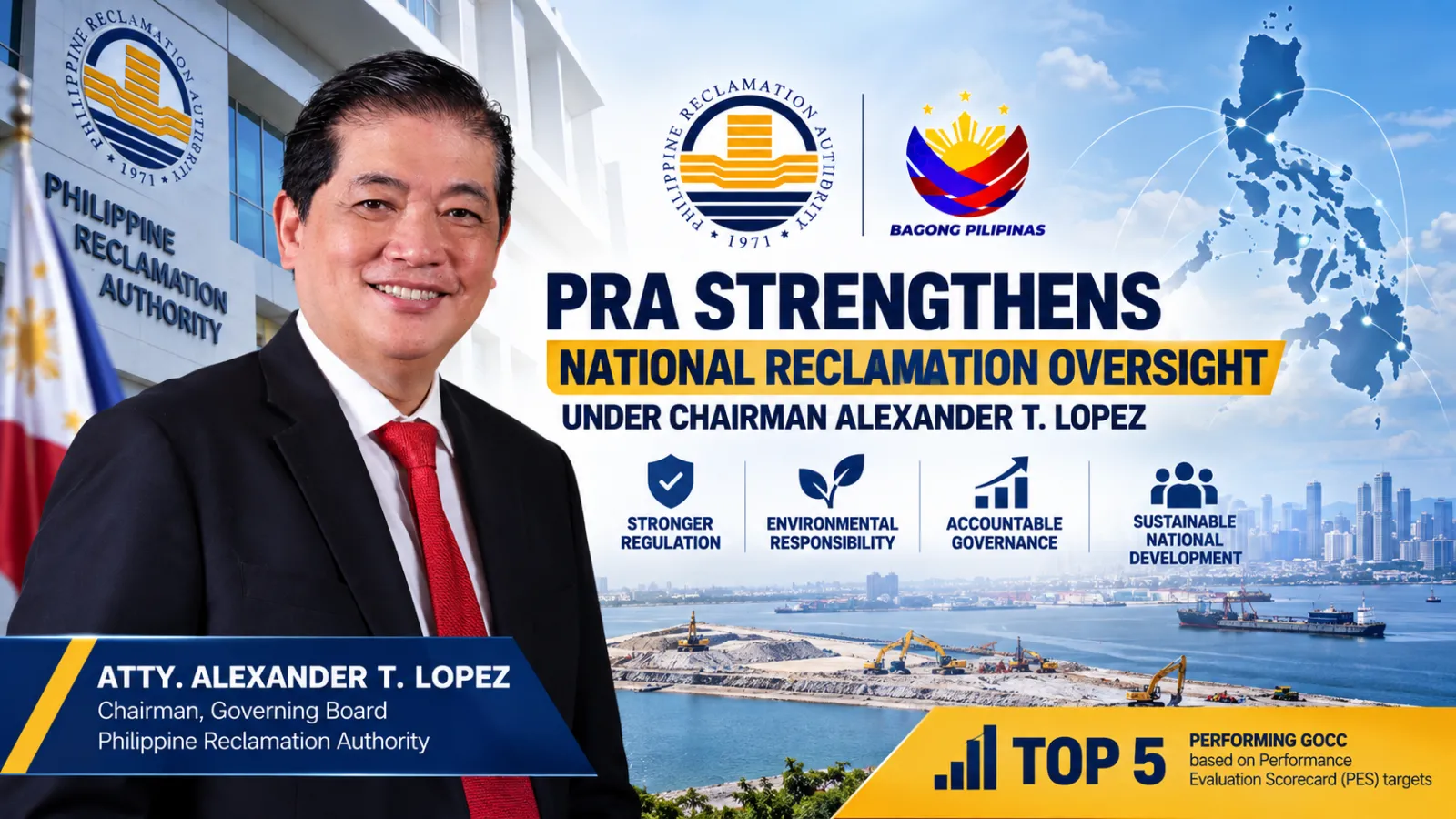
Under Chairman Atty. Alexander T. Lopez, PRA strengthens nationwide reclamation oversight, good governance and responsible development for the Filipino people.
MANILA, Philippines — The Philippine Reclamation Authority (PRA), under the leadership of Chairman and Governing Board Chair Atty. Alexander T. Lopez, is strengthening its national regulatory mandate as it advances responsible reclamation, regulatory compliance, environmental safeguards, and institutional accountability across the country.
At the center of Lopez’s leadership is a clear direction for the PRA: reclamation must support national development while remaining firmly anchored on law, proper government authorization, transparency, and the protection of the public interest.
With reclamation increasingly connected to major infrastructure, economic development, coastal growth, and urban expansion, Lopez has emphasized the importance of the PRA exercising strong and consistent oversight over reclamation activities nationwide.
“Reclamation is not simply about creating new land. It is about ensuring that development is properly planned, legally undertaken, environmentally responsible, and beneficial to the Filipino people,” Lopez said.
Strengthening Regulatory Oversight Nationwide
Under Lopez’s leadership, the PRA continues to reinforce its role in ensuring that reclamation activities throughout the Philippines undergo the appropriate evaluation, authorization, and regulatory processes.
The Authority’s recent enforcement action involving an unauthorized reclamation project in Laguna de Bay demonstrates this broader national policy of regulatory vigilance.
In coordination with the Department of Public Works and Highways (DPWH), the PRA issued a cease-and-desist order against the unauthorized reclamation activity.
The PRA also formally directed the DPWH to submit a complete inventory of projects within Laguna de Bay containing reclamation components, an initiative aimed at determining the authorization and regulatory status of these activities and establishing accountability for reclamation-related works.
Rather than being an isolated enforcement action, the move reflects the PRA’s broader responsibility to ensure that reclamation activities—wherever they may be undertaken in the country—comply with established laws, regulations, environmental requirements, and government approval processes.
For Lopez, effective regulation requires both decisive enforcement and coordination among government agencies.
“The PRA must be proactive in carrying out its mandate. Where reclamation activities require government authorization, there must be accountability, proper coordination, and compliance with the law. These principles must apply consistently across the country,” Lopez said.
Reclamation as Part of National Development
Lopez is also advancing a broader view of the PRA’s role in national development.
As the Philippines continues to address infrastructure requirements, urbanization, economic expansion, coastal development, and the need for strategically planned growth areas, reclamation can play a role in creating opportunities for development.
But Lopez has stressed that such opportunities must be balanced against environmental considerations, community interests, regulatory requirements, and long-term national priorities.
This places the PRA in a critical position: facilitating legitimate development while serving as a strong regulatory institution protecting the public interest.
The Authority continues to work with national government agencies, local government units and other stakeholders to ensure that proposed and existing reclamation activities are subjected to appropriate government processes.
Stronger Institution, Stronger Governance
The PRA’s strengthened regulatory direction is being complemented by improvements in institutional performance.
The Authority was recognized as the 5th top-performing Government-Owned and Controlled Corporation (GOCC) based on its performance against its Performance Evaluation Scorecard (PES) targets.
The recognition reflects the PRA’s continuing efforts to strengthen organizational effectiveness, governance, accountability, and the delivery of its mandate.
For Lopez, strong institutional performance is directly connected to effective regulation.
“For the PRA to effectively perform its national mandate, the institution itself must be strong, credible, responsive, and accountable. Good governance within the Authority strengthens our ability to serve government, our stakeholders, and ultimately the Filipino people,” Lopez said.
A Stronger PRA for the Country
Under Lopez’s chairmanship, the PRA is reinforcing its identity not merely as an agency associated with reclamation projects, but as the government’s regulator and steward of responsible reclamation development in the Philippines.
The direction is anchored on stronger regulatory oversight, inter-agency coordination, environmental responsibility, transparency, accountability, and institutional performance.
As the country continues to pursue infrastructure and economic development, Lopez said the PRA will remain focused on ensuring that reclamation contributes to national progress without compromising regulatory standards and the long-term public interest.
“Our responsibility is national in scope. We must ensure that reclamation, wherever it is undertaken in the Philippines, is pursued responsibly, lawfully, transparently, and with the welfare of future generations in mind,” Lopez said.
Through stronger regulation and stronger institutional governance, the PRA under Lopez is working toward a clear objective: responsible reclamation that supports sustainable and inclusive national development.
About the Philippine Reclamation Authority
The Philippine Reclamation Authority (PRA) is the government agency tasked with regulating and overseeing reclamation activities in the Philippines. It works with national government agencies, local government units, and other stakeholders to ensure that reclamation activities undergo appropriate government processes and contribute to responsible and sustainable national development.